We carefully package every order to help ensure your records and media arrive safely. Orders are typically processed promptly, and tracking information is provided once your shipment is on its way.
Shipping costs and delivery estimates are calculated at checkout based on your location and selected shipping method.
We want you to shop with confidence. If there's an issue with your order, we're here to help.
New, unopened items may be returned in accordance with our Return Policy. For complete details, including return eligibility and timeframes, please review our full Return Policy before making your purchase.
Whether you're buying your first record or adding a rare pressing to your shelves, understanding editions, formats, and release details can help you make informed collecting decisions. At Vibin' Vinyl, we believe collecting is about more than just owning the music—it's about appreciating the artwork, packaging, mastering, and history behind every release.
Looking to expand your collecting knowledge?
Explore our Collector's Guide for tips, format guides, and collecting advice.
Composer: Leonard Bernstein.
Lyricist: Stephen Sondheim.
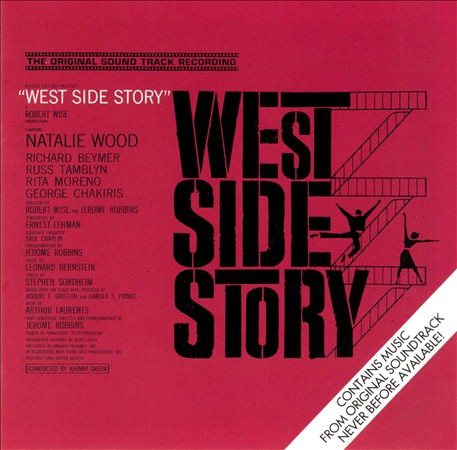
Hollywood has a deservedly bad reputation for its adaptations of Broadway musicals, but, at least as of the mid-'50s, with Broadway powers like Rodgers & Hammerstein getting some control over the film versions of their works, some degree of greater fidelity has been achieved, in the sense that the movies tend to use much of the scores heard on-stage, without interpolating new, irrelevant material. One tendency Rodgers & Hammerstein pictures (notably South Pacific) have made heavy use of, however, is to have one cast acting on the screen and something close to an entirely different one singing in the recording studio, and that is very much the case with regard to West Side Story. Jerome Robbins, who directed the Broadway show, was co-director of the movie, so it's not surprising that there is some approximation on film of what was seen on-stage. But the story has been rearranged somewhat. Thankfully, the casting, including the use of Natalie Wood, an actress of Russian/French extraction, as the supposedly Puerto Rican Maria, is the not the concern of a reviewer of the soundtrack album, particularly because Wood's singing voice has been replaced by that of the magnificent Marni Nixon. As it happens, so have the singing voices of nearly all the onscreen performers. The equally miscast Richard Beymer, as Tony, is voiced here by the excellent Jim Bryant. After those basic substitutions, things get a little complicated, however. That's the voice of Tucker Smith, who plays another of the gang the Jets, coming out of the mouth of Russ Tamblyn as Riff in "Jet Song," but Tamblyn gets to do some of his own singing in "Gee, Officer Krupke!" and "Quintet." Studio singer Betty Wand sings for Rita Moreno as Anita in "America" and "A Boy Like That," but in "Quintet," Nixon handles the voices of both Maria and Anita! Nevertheless, much of Leonard Bernstein's score, a fresh mixture of pop, jazz, and classical elements, remains in the original Irwin Kostal/Sid Ramin orchestrations, and Stephen Sondheim's clever lyrics are well sung, whoever may be doing that singing. "America," one of the cleverest songs, has had its words toned down, however, and the sense of the song as a verbal duel between the characters Anita (who criticizes Puerto Rico) and Rosalia (who defends it) is completely lost by having all members of the gang the Sharks, with leader Bernardo (George Chakiris, doing his own singing) prominent among them, singing various lines. Now, you can't make sense of the original back and forth, and much of the point of the lyric is lost. Oh, well. It's still great dance music, which is also true of much of Bernstein's score. And the ballads remain moving, especially when they're being sung by Nixon and Bryant. The West Side Story soundtrack album is no substitute for the original Broadway cast recording, but it is much better than most such versions of show scores. ~ William Ruhlmann